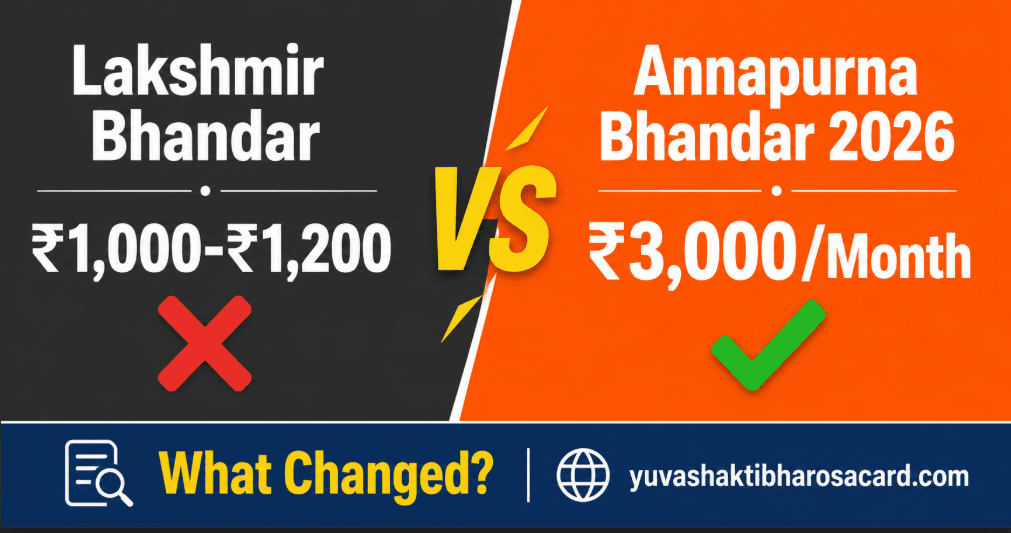
If your mother, wife, or sister has been getting Lakshmir Bhandar money every month, the question right now is simple: will that payment stop, or will it become ₹3,000?
With West Bengal’s new BJP government announcing the Annapurna Bhandar scheme, a lot of confusion has spread — and not all of it accurate. Some people have heard the old scheme is cancelled. Others think they’ll get both payments together. Neither is quite right.
This article breaks down the Lakshmir Bhandar vs Annapurna Bhandar comparison clearly, so you know exactly what’s changing, what’s staying, and what you need to do right now.
First, What Was Lakshmir Bhandar?
The Lakshmir Bhandar scheme was launched by the TMC government in August 2021. At its peak, it was reaching over 2 crore women across West Bengal — one of the largest direct benefit programs the state had ever run.
Here’s how it worked:
- Women from general category households received ₹500/month initially, later revised to ₹1,000/month
- Women from SC/ST households received ₹1,000/month, later revised to ₹1,200/month
- Eligibility: women aged 25–60 years, typically the head of household
- Payment method: DBT directly to a bank account
The scheme was popular — not because ₹1,000 is a large amount, but because for millions of women in rural and semi-urban Bengal, it was the first time any money arrived in their own name, in their own account. That sense of financial identity mattered.
The limitation, though, was real. Between 2021 and 2026, the cost of essentials — rice, cooking oil, medicines — climbed steadily. The ₹1,000 that felt meaningful in 2021 covered noticeably less by 2025. The government made minor revisions, but no significant overhaul.
Status as of May 2026: Lakshmir Bhandar payments are being transitioned to the new Annapurna Bhandar scheme. Payments will continue during the transition period.
Now, What Is Annapurna Bhandar?
The Annapurna Bhandar scheme was announced on May 11, 2026, at the very first cabinet meeting of the new BJP government under Chief Minister Suvendu Adhikari. It wasn’t buried in a list of announcements — it was one of the first decisions made, which signals how central it is to the new government’s positioning with women voters.
The headline number: ₹3,000 per month, flat, for all eligible women — regardless of general or SC/ST category. No tiered amounts.
Key facts at a glance:
- Monthly Payment: ₹3,000 (uniform for all eligible women)
- Target Group: Women from low-income and EWS (Economically Weaker Section) families
- Transfer Mode: DBT to Aadhaar-linked bank account
- Expected Launch: June 1, 2026
- Part of: The larger Matrishakti Bharosa Card program
That last point is important and often misunderstood — we’ll explain the Matrishakti connection properly below.
Read More : Annapurna Bhandar Yojana 2026 — Form PDF, Online Apply, Eligibility & Payment Status (Complete Guide)
For a complete breakdown of everything about the new scheme, read our full Annapurna Bhandar Scheme 2026 guide.
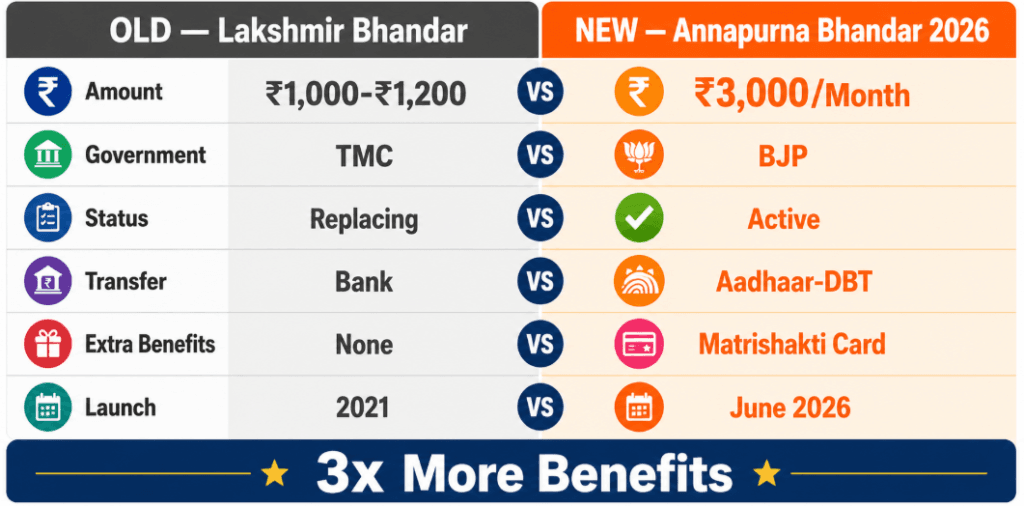
Lakshmir Bhandar vs Annapurna Bhandar — Full Comparison Table
Here’s every meaningful difference between the two schemes, side by side:
| Feature | Lakshmir Bhandar (Old) | Annapurna Bhandar (New) |
|---|---|---|
| Monthly Amount | ₹500–₹1,200 | ₹3,000 |
| Government | TMC | BJP |
| Launched | August 2021 | June 2026 (Expected) |
| Transfer Mode | DBT to bank account | DBT to Aadhaar-linked bank |
| Age Requirement | 25–60 years | 25+ years (no upper limit expected) |
| Ration Card Required | Not initially mandatory | BPL / AAY / PHH expected |
| SC/ST Extra Benefit | ₹200 extra/month | No — flat ₹3,000 for everyone |
| Verification Level | Basic | Strict Aadhaar-bank verification |
| Linked Program | Standalone | Matrishakti Bharosa Card |
| Additional Benefits | None | Pregnancy ₹21K, Graduation ₹50K, Mudra Loan |
| Status | Being replaced | Launching June 2026 |
The headline difference is obvious — ₹1,200 vs ₹3,000. But two other changes deserve attention:
1. The upper age cap is likely gone. Lakshmir Bhandar had a 60-year ceiling. Early indications suggest Annapurna Bhandar will not have one — which means women over 60 who were previously excluded may now qualify.
2. SC/ST women lose the extra ₹200, but gain far more overall. Under Lakshmir Bhandar, SC/ST women got ₹1,200 while general category women got ₹1,000. Under Annapurna Bhandar, both get ₹3,000 — a net gain of ₹1,800/month for SC/ST women and ₹2,000/month for general category women.
Can You Get Both Lakshmir Bhandar and Annapurna Bhandar at the Same Time?
No. This is a replacement, not an addition.
The Annapurna Bhandar scheme is designed to take over from Lakshmir Bhandar entirely. You won’t receive ₹1,000 from the old scheme and ₹3,000 from the new one simultaneously. What happens instead:
- Existing eligible Lakshmir Bhandar beneficiaries will be migrated to Annapurna Bhandar after a verification process.
- The government will conduct a beneficiary list review — removing names that were added incorrectly or fraudulently under the previous regime.
- Once migrated and verified, you receive ₹3,000 instead of your previous ₹1,000 or ₹1,200.
So the practical outcome for most genuine beneficiaries is straightforward: the amount goes up, the scheme name changes, and your bank account still gets credited every month.
The concern for some women is whether they’ll pass the verification. If your documents are in order — especially your Aadhaar-bank linkage — there’s no reason to worry. The verification is aimed at removing bogus entries, not genuine beneficiaries.
What Does the Matrishakti Bharosa Card Have to Do With This?
A lot of people are confused when they see both names mentioned together. Here’s the clear explanation:
The Matrishakti Bharosa Card is the BJP’s broader women’s welfare program — think of it as an umbrella scheme. The Annapurna Bhandar monthly payment is one benefit under that umbrella. But it’s not the only one.
If you hold the Matrishakti Bharosa Card, you may also be eligible for:
| Benefit | Amount |
|---|---|
| Monthly Financial Support | ₹3,000/month (Annapurna Bhandar) |
| Pregnancy Support | ₹21,000 (one-time) |
| Graduation Bonus | ₹50,000 (one-time) |
| Child Nutrition Support | ₹36,000 |
| Mudra Loan for Women Entrepreneurs | Up to ₹20 Lakh |
So when you’re asking about Lakshmir Bhandar vs Annapurna Bhandar, the honest answer is that it’s not just a ₹2,000/month upgrade — it’s a shift from a standalone payment to being part of a much larger benefits ecosystem.
What You Need to Do Right Now
If you or someone at home is currently receiving Lakshmir Bhandar payments, here’s a practical action plan — not generic advice, but the specific things that actually matter:
Step 1: Check your Aadhaar-bank linkage today. This is the single most important thing. Annapurna Bhandar payments go through Aadhaar-linked DBT only. If your Aadhaar isn’t seeded to your bank account, your migration will stall regardless of how valid your other documents are. Check at your bank branch or the UIDAI website.
Step 2: Keep these documents accessible. Voter ID, ration card (BPL/AAY/PHH), Aadhaar card, and bank passbook. Keep physical copies and scanned copies on your phone. If the portal opens and sees high traffic, you want to be ready.
Step 3: Don’t apply anywhere yet. The official portal hasn’t launched. Any website currently accepting “Annapurna Bhandar registrations” is fraudulent. Wait for the announcement on wb.gov.in.
Step 4: If you’re over 60 and were previously excluded from Lakshmir Bhandar, watch this space carefully. The removal of the upper age cap (if confirmed officially) could make you newly eligible.
Step 5: Read about the full Matrishakti Bharosa Card benefits. You may qualify for more than just the monthly ₹3,000. Our Matrishakti Bharosa Card 2026 guide has the complete breakdown.
If there’s an unemployed young person in your household, also check the Yuva Shakti Bharosa Card — a separate ₹3,000/month scheme for unemployed youth. For a full picture of all new programs, see our West Bengal BJP Schemes 2026 guide.
One Thing to Be Careful About — The Scam Wave
Every time a major welfare scheme is announced in India, two things happen within days: the government gets busy planning, and fraudsters get busy exploiting confusion.
The Lakshmir Bhandar to Annapurna Bhandar transition is being actively used as a scam hook. People are calling Lakshmir Bhandar beneficiaries claiming they need to “transfer” their registration to the new scheme for a fee. Others have set up fake websites that look official enough to fool someone in a hurry.
Be direct about this with your family members:
- ❌ Do not pay anyone — agent, shop, or individual — to transfer your registration. This service doesn’t exist. The migration is handled by the government.
- ❌ Do not share your Aadhaar number or bank details on any site other than the official government portal.
- ❌ Do not download any app claiming to register you for Annapurna Bhandar. There is no official app yet.
- ❌ If someone calls saying your Lakshmir Bhandar will stop unless you pay ₹500 to transfer to the new scheme — that is a scam. Hang up.
✅ All legitimate registration and migration for this scheme will happen only through wb.gov.in or the official government portal announced through verified channels.
Has Lakshmir Bhandar been stopped completely?
Not yet. Lakshmir Bhandar payments are continuing during the transition period. The government has said the new Annapurna Bhandar scheme will take over from June 1, 2026 — until then, the old payments should not stop abruptly for existing beneficiaries.
Will I automatically get ₹3,000 instead of ₹1,000?
If you’re an existing Lakshmir Bhandar beneficiary who meets the Annapurna Bhandar eligibility criteria, the government expects to migrate you automatically after verification. You don’t need to do anything except ensure your Aadhaar and bank details are current.
What if my name gets removed during verification?
The review is specifically targeting fraudulent or ineligible entries — not genuine beneficiaries. If your documents are valid and your Aadhaar is linked to your bank account, you should clear verification without any issue.
Is the Annapurna Bhandar scheme the same as the Matrishakti Bharosa Card?
They’re connected but not the same thing. Annapurna Bhandar is the monthly ₹3,000 payment that forms one part of the Matrishakti Bharosa Card program. The Card also unlocks separate one-time benefits like pregnancy support and a graduation bonus.
When will the ₹3,000 payment actually start hitting accounts?
The scheme launches June 1, 2026. But the first payment into your account will come after your application is verified — typically 30–60 days after submission. Keep checking this page for updates as official dates are confirmed.
In the Lakshmir Bhandar vs Annapurna Bhandar comparison, the numbers aren’t even close. ₹3,000 vs ₹1,200 is a real, meaningful jump — ₹21,600 more per year for a general category woman, ₹21,600 more for SC/ST women too (₹1,800 × 12).
The transition period creates some uncertainty, and the verification process means not everyone will automatically roll over. But for genuine beneficiaries with updated documents — particularly Aadhaar-bank linkage — the new scheme is a straightforward improvement.
The one thing to avoid right now is acting out of panic. Don’t pay anyone. Don’t apply anywhere unofficial. Just get your Aadhaar linked and your documents ready, and wait for the official portal.
📌 Bookmark this page — we’ll update it the moment transition timelines and portal links are officially announced.
📌 Share with anyone currently on Lakshmir Bhandar — they deserve accurate information, not WhatsApp rumours.
📌 Follow our WhatsApp Channel for instant updates, no spam.

Also Read:
- Annapurna Bhandar Scheme 2026 — Complete Apply Guide
- Matrishakti Bharosa Card 2026 — All Benefits Explained
- Yuva Shakti Bharosa Card 2026 — ₹3,000 for Unemployed Youth
- West Bengal BJP Schemes 2026 — Full List
Disclaimer: This website (yuvashaktibharosacard.com) is a completely unofficial and independent information blog. It is not affiliated with the West Bengal Government or BJP in any way. Information published here is kept as accurate as possible, but we cannot guarantee the accuracy of all details. For official information, always verify from wb.gov.in.